
 Sign in






Decapower Curated information for Professionals, Hobbyists & Educators.
Stay up to date with the latest information on new products technology,innovations and more from Welding Machine Industry.







Why Aluminum Requires Specialized Settings and Double Pulse Control
Introduction: The Aluminum Challenge
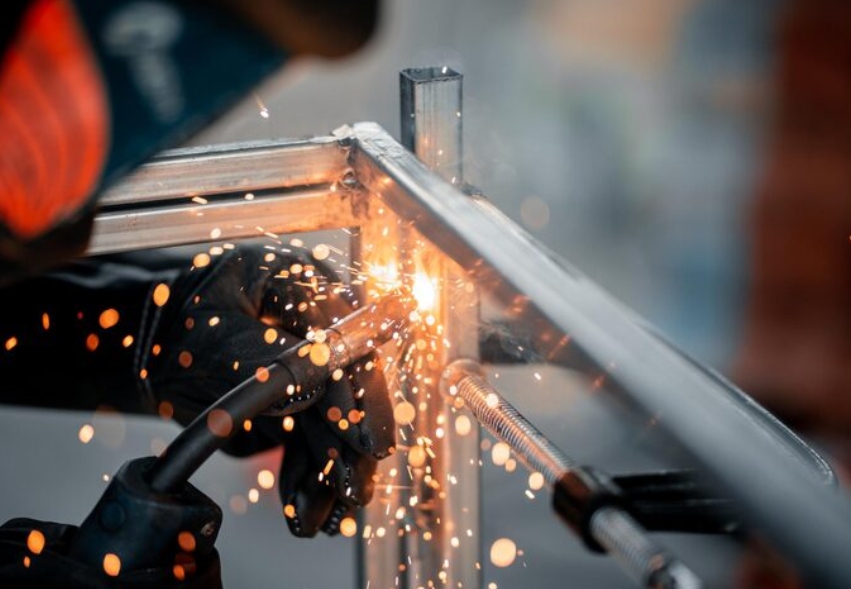
Aluminum remains a top choice in automotive, aerospace, and everyday fabrication because it stays light, fights rust well, and looks good in almost any finish. Yet every experienced welder also knows that aluminum can turn a straightforward job into a real headache. Its unusual behavior in the heat demands far more than ordinary welding setups. To get clean, strong results, welders need precise machine settings and advanced features such as Double Pulse control. This is exactly the field where Decapower specializes.
The Paradox of Aluminum Welding
Aluminum melts at a surprisingly low temperature while conducting heat extremely fast. The moment the arc touches the metal, heat races away from the weld zone into the rest of the workpiece. That rapid escape often leaves cold laps and weak fusion. Add a little too much power, and the same piece can burn straight through or warp badly. On top of that, regular MIG welding on aluminum usually creates heavy spatter and rough, uneven beads that demand hours of grinding afterward.
Why Conventional MIG Falls Short
Standard constant-voltage MIG works fine on mild steel, but it simply cannot keep up with aluminum’s heat demands. Welders constantly fight a losing battle: run the machine hot enough to get proper penetration and risk burning holes; turn the power down to stay safe and end up with welds that barely tie the parts together. For anyone who needs repeatable quality, low distortion, or a clean appearance right off the gun, old-style MIG just does not deliver.
Mastering Aluminum: Specialized Settings
The real answer lies in moving away from basic constant-voltage power and switching to pulsed waveform control.
High Conductivity and Heat Input Control
Success with aluminum comes down to putting in exactly the right amount of heat — no more, no less. Pulse MIG does this by quickly raising the current to form the pool and then dropping it again so the metal can cool just enough before the next cycle. This fast on-off rhythm keeps the weld deep and strong without letting the surrounding area get too hot.
Understanding Pulse MIG Technology
Pulse MIG (sometimes called GMAW-P) is a smarter version of ordinary MIG. Instead of feeding steady power, the machine rapidly switches between a high peak current and a much lower background current.
Peak Current vs. Background Current
During the short peak period, the current jumps high enough to detach one clean droplet from the wire and send it across in smooth spray transfer. Spatter almost disappears because nothing explodes in short-circuit style. Right after, the background current falls low enough to hold the arc but let the puddle cool a few degrees. Hundreds of these cycles happen every second, giving the welder tight command over heat.
Benefits: Less Spatter and Distortion
Because heat stays under control, spatter drops dramatically, and the bead stays smooth. On thin sheet or heat-sensitive parts, the difference shows immediately — far less warping and almost no cleanup.
The Precision of Double Pulse Control
Single-pulse MIG already works well, but Double Pulse adds another layer of control and delivers even better-looking results.
Achieving Aesthetic and Structural Integrity
Double Pulse places a slower, secondary pulse on top of the fast primary pulse. This extra rhythm gently rocks the weld pool back and forth. The motion produces the classic “stacked dimes” look that many customers love, yet the process still runs at normal MIG speeds.
How Double Pulse Elevates GMAW Performance
Welders choose Double Pulse on aluminum for three main reasons:
Enhanced Thermal Control
The alternating hot-cold phases keep the pool from becoming overly runny. That control matters greatly on thin material or when heat buildup could ruin the job.
Improved Fusion and Penetration
Each strong pulse drives the weld a little deeper, so joints come out fully fused and mechanically sound.
Low Spatter and Consistent Finish
Spatter nearly vanishes, and every bead looks the same from start to finish. Post-weld grinding time often drops by half or more.
DECAPOWER Solutions for Aluminum Welding
Decapower builds machines specifically for tough materials like aluminum, with a strong focus on GMAW, GTAW, SMAW, and plasma cutting.
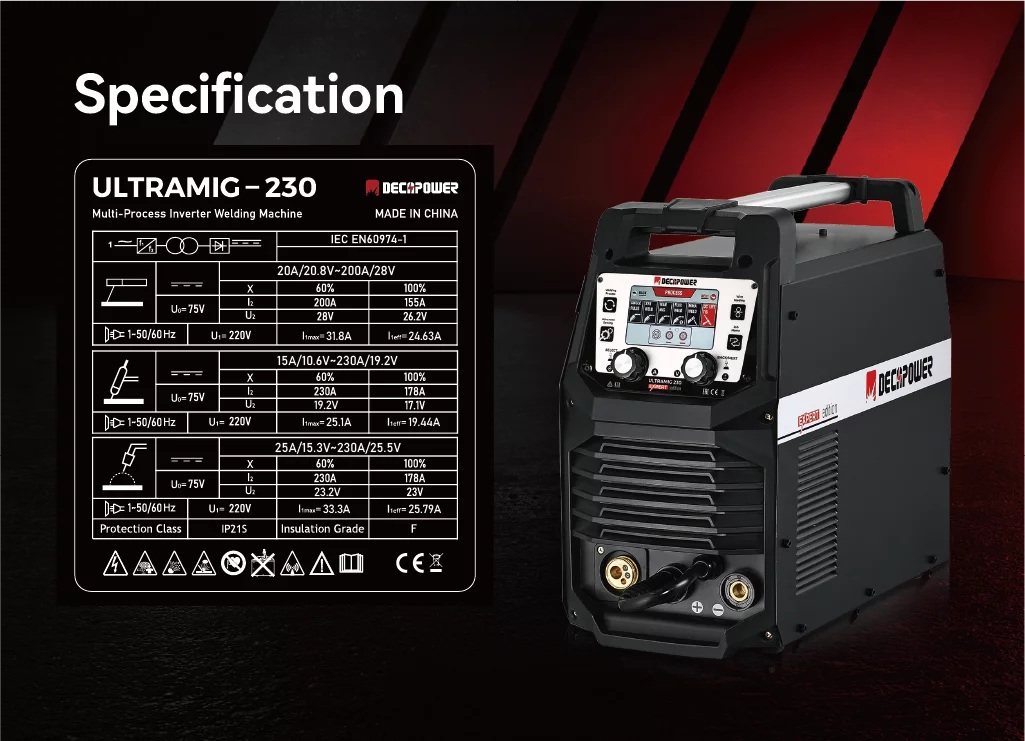
The Ultimate Control: ULTRAMIG-230 EXPERT Double Pulse MIG
The ULTRAMIG-230 EXPERT Double Pulse MIG Aluminum Welding Machine was created for fabricators who need top-tier aluminum performance.
Key Features and Advantages
Full-bridge inverter and pure digital control give rock-steady arcs and high efficiency.
Double Pulse Capability – switch between normal pulse and true Double Pulse whenever the job demands perfect beads and minimum cleanup.
Multi-Process Versatility – handles synergic MIG, manual MIG, stick, and TIG, so the same machine works on steel, stainless, and aluminum.
Targeted Application – ideal for light production shops and custom fabrication.
Versatility and Synergy: XTRAMIG-200 Multi-process Welder
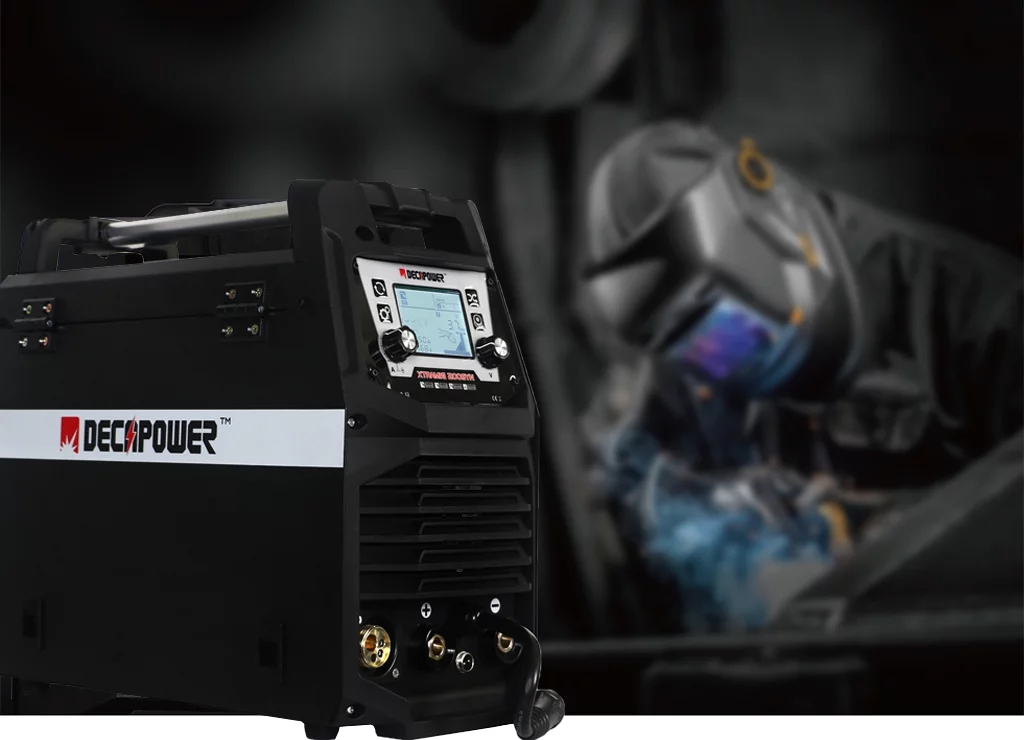
The XTRAMIG-200 Multi-process MIG/MAG/MMA/TIG Synergic Welding Machine with LCD Displayer packs several processes into one compact unit.
Synergic Control and Aluminum Capability
Built-in synergic programs let the machine set voltage and wire speed automatically once the operator chooses the material and thickness. Users regularly weld 6 mm aluminum without burn-through or lack of fusion, and the low-spatter arc saves considerable finishing time.
All-in-One Power: FUSION PMCT-205 Multi-process 6-in-1
The FUSION PMCT-205 combines MIG (synergic, manual, and pulse), stick, HF TIG, and 50 A plasma cutting in a portable package.
Integrated Pulse MIG and Cutting Capabilities
The pulse MIG mode delivers the same clean aluminum welds discussed earlier, while the built-in cutter handles quick cut-offs and prep work on the same bench.
Beyond the Machine: Customized Welding Support
Decapower stays close to customers and continually improves based on real shop feedback.
Tailoring Solutions to Your Exact Needs
The engineering team can add spool guns, change colors, print custom logos, or build complete OEM machines to match exact specifications. Even small changes are possible when order volumes make sense.
Partnership for Performance
By learning the specific challenges each shop faces, Decapower suggests or builds the exact package that works best day after day.
Conclusion: Weld Smarter, Not Harder
Aluminum welding no longer has to mean constant compromise. Advanced pulse and Double Pulse machines from Decapower — especially the ULTRAMIG-230 EXPERT, XTRAMIG-200, and FUSION PMCT-205 — give welders the heat control, speed, and appearance that used to require slow TIG. The result is cleaner work, stronger joints, and far less time spent grinding.
FAQ
Q: What advantage does Double Pulse MIG offer over standard Pulse MIG for aluminum?
A: Double Pulse gives faster travel speeds, noticeably better bead appearance with the “stacked dime” look, and even tighter heat control.
Q: Do Decapower welding machines support welding aluminum?
A: Yes. The ULTRAMIG-230 EXPERT is built as a dedicated Double Pulse aluminum machine, and the XTRAMIG and FUSION lines also handle aluminum very well.
Q: What are the main benefits of Pulse MIG technology in general?
A: Lower heat input, almost no spatter, smoother beads, and much less distortion — exactly what thin or heat-sensitive metals need.
Q: Can Decapower customize welding machines for specific user requirements?
A: Yes. Through OEM and ODM programs, we can modify or build machines to fit special needs, from simple logo changes to full custom designs.